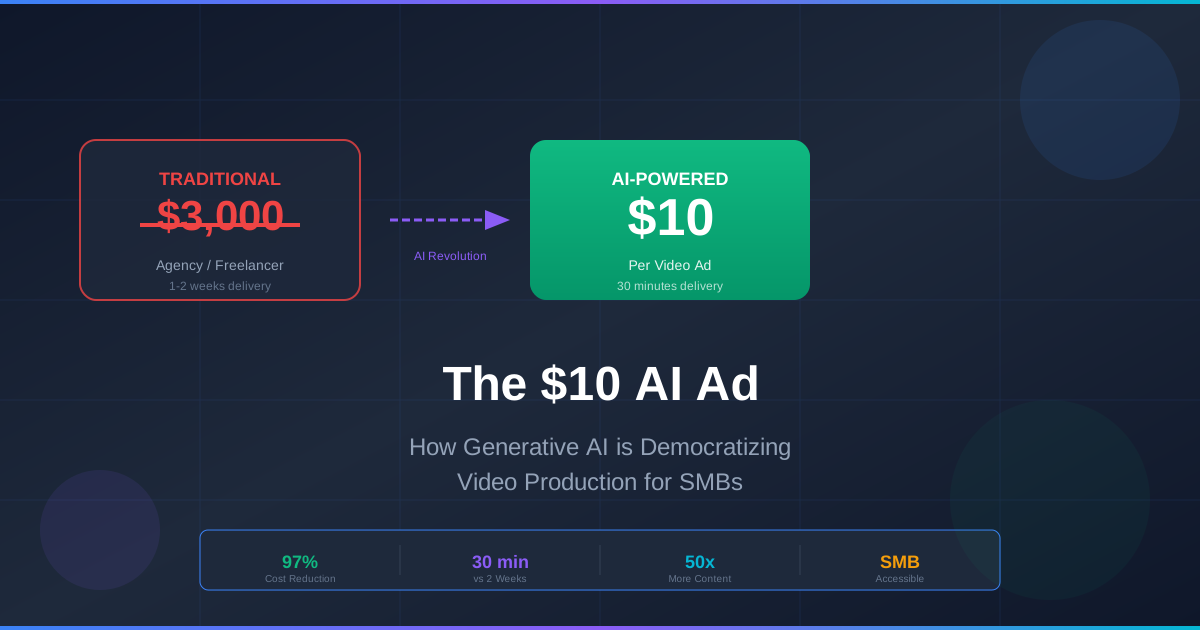
The $10 AI Ad: How Generative AI is Democratizing Video Production for SMBs
What used to cost $500 and a week of back-and-forth with a freelancer can now be done in 30 minutes for the price of a lunch. Here's how AI is collapsing the cost of quality video ads.
A few weeks ago, a tweet caught my attention. David Roberts, an AI automation builder, posted a video ad he'd created for a fragrance brand. The ad looked polished—professional lighting, smooth camera movements, a compelling spokesperson delivering the pitch. The kind of video you'd expect from a production agency with a decent budget.
Then came the kicker: he made it in 30 minutes. For about $10 worth of AI credits.
The comments exploded. Some people were skeptical. Others were fascinated. A few agency owners were probably quietly panicking. Because what David demonstrated wasn't just a neat trick—it was a preview of how video advertising is about to fundamentally change for millions of small businesses.
The $4,000 Problem Nobody Talks About
Here's a scenario that plays out thousands of times every day. A small business owner—let's call her Maria—runs a local bakery. She knows she needs video content for Instagram and Facebook. Her competitors are doing it. The algorithms favor video. Her customers respond to it.
So Maria reaches out to a local video production agency. She just wants something simple: a 30-second ad showing her pastries, maybe a quick shot of the kitchen, some upbeat music. Nothing fancy.
The quote comes back: $2,500 to $4,000.
Maria's stomach drops. That's her marketing budget for the next three months. For a single 30-second video.
This isn't an outlier. A recent thread on Reddit's r/n8n forum told a nearly identical story. A user's father needed a simple video ad for his local business. Nothing elaborate—just a generic talking head, some light editing, maybe 30-40 seconds total. The agencies he contacted quoted between $2,500 and $4,000. For what should have been a straightforward project.
The traditional video production cost structure has remained stubbornly high for years. Freelance video editors typically charge $30 to $100 per hour. A simple promotional video, even at the lower end, requires scripting, filming (or sourcing footage), editing, color correction, sound design, and revisions. That adds up fast. Even going the "cheap" route with a freelancer on Fiverr or Upwork, you're looking at $300 to $500 minimum for anything that doesn't scream "amateur."
And it's not just the money. It's the time. The back-and-forth on creative direction. The revision cycles. The communication overhead. By the time Maria gets her final video, three weeks have passed, her promotion window has closed, and she's exhausted from the process.
This is the reality that has kept professional video advertising out of reach for most small businesses. They either pay premium prices they can barely afford, settle for obviously low-quality content, or simply don't create video at all.
Until now.
The Technology Stack That Changed Everything
To understand how we got to $10 AI ads, you need to understand what happened in AI video generation over the past 18 months. The convergence of several technologies created a perfect storm that's now reshaping video production.
The first piece was large language models becoming sophisticated enough to understand creative briefs and generate coherent scripts. When you tell GPT-4 or Claude that you need a 30-second ad for a local bakery targeting working professionals, it can now produce scripts that actually work. Not just grammatically correct text, but structured content with hooks, value propositions, and calls to action in the right places.
The second piece was video generation models reaching commercial quality. Google's Veo 3, OpenAI's Sora 2, Kling AI, and others can now generate footage that's genuinely usable. Not perfect—we'll talk about limitations later—but good enough for social media advertising. The jump from "interesting tech demo" to "production-ready tool" happened remarkably fast.
The third piece was voice synthesis crossing the uncanny valley. Services like ElevenLabs can now generate voiceovers that sound natural, with proper pacing, emotional range, and even the subtle imperfections that make speech feel human. You can clone voices, adjust for different languages, and produce broadcast-quality audio in seconds.
The fourth piece was automation platforms making these tools accessible. Tools like n8n and Make allow non-programmers to chain these AI services together into workflows. What would have required a development team six months ago can now be built in a weekend by someone with basic technical skills.
When you combine these four elements, you get something that was impossible two years ago: a system that can take a text description of what you want and produce a complete video advertisement, end to end, without human intervention in the middle.
Inside the $10 Ad: Breaking Down the Process
Let's get concrete about how this actually works. The Reddit user who built an AI ad generator for his father shared his entire workflow, and it reveals just how dramatically the process has changed.
The system starts with format selection. This isn't arbitrary—different advertising goals call for different structures. A spokesperson format works when you need to establish authority and deliver a direct message. Customer testimonials build trust through social proof. Results showcases work when you have compelling before/after stories. The AI needs to know which playbook to follow.
Once the format is selected, GPT takes over script generation. This isn't just writing copy—it's creating a complete production document. Each scene gets a time allocation, camera direction notes, and delivery guidance. The AI understands that a hook needs to land in the first three seconds, that the value proposition should hit around the 10-second mark, and that the call to action needs enough time at the end without dragging.
The script then gets transformed into Veo3-ready prompts. This is where the technical sophistication really shows. Each scene description gets enriched with camera framing details, tone indicators, pacing notes, and visual specifics. A line like "Show the product" becomes a detailed prompt specifying camera angle, lighting style, depth of field, and movement—all optimized for what the video model can actually execute well.
The system then sends these prompts to Veo3's API, handles the job queue, polls for completion, and retrieves the generated clips. If voiceover was requested, those audio files get aligned to the scene timing. Finally, everything gets assembled into a complete rendered advertisement.
The entire process—from product description to finished ad—takes about 30 minutes. The actual human time required? Maybe five minutes to input the initial brief and review the output.
The Real Costs: Breaking Down a $10 Ad
Let's trace the actual money flow for one of these AI-generated advertisements.
The LLM costs for script generation and prompt optimization run about $0.50 per ad. This covers multiple API calls—initial script generation, prompt enrichment for each scene, and any refinements. Video generation is the bulk of the cost at around $6 for a 30-second ad with multiple scenes. Voice synthesis adds about $1.50 for a professional-quality voiceover. Processing, assembly, and platform overhead account for the remaining $2.
Compare this to the traditional alternatives. A budget freelancer on Upwork might charge $300-$500 for a similar ad, requiring multiple rounds of feedback and a week or two of elapsed time. A local agency starts at $2,500 and goes up from there, often requiring contracts, meetings, and multi-week timelines.
The math is stark: a small business could create 30 to 50 AI-generated ads for the cost of a single freelancer project.
What This Means for Small Business Marketing
The implications of this cost collapse extend far beyond individual ad creation. It's reshaping how small businesses can approach marketing entirely.
Consider the traditional small business advertising constraint. Maria, our bakery owner, might have budgeted $3,000 per quarter for video marketing. Under the old model, that bought her maybe one or two professional videos. She had to make every piece of content count, which meant playing it safe—generic messages designed to appeal to everyone, which often meant they resonated with no one.
With AI-generated ads at $10 each, that same $3,000 quarterly budget now buys 300 pieces of video content. This doesn't just change the math—it changes the strategy.
Suddenly, Maria can create different ads for different customer segments. One version for busy parents who want quick breakfast options. Another for office workers looking for catering. A third for people planning birthday celebrations. Each message can be precisely tailored to resonate with its specific audience.
She can test different hooks, different offers, different calls to action. When she sees that one approach is outperforming others, she can quickly generate variations to double down on what's working. The cost of failure drops so low that experimentation becomes the default mode rather than a risky exception.
This is the shift from "precious content" thinking to "prolific testing" thinking. When each piece of content is expensive, you guard it carefully and optimize for not failing. When content is cheap, you optimize for learning—and the learnings compound.
The Limitations: What AI Video Ads Can't Do (Yet)
It would be irresponsible to paint this as a solved problem. AI video generation has made remarkable progress, but significant limitations remain. Understanding these boundaries is crucial for anyone considering this technology.
⚠️ Current AI Video Limitations
These constraints are real and affect what kind of content you can successfully create with AI today:
Brand consistency presents the first major challenge. If Maria has a specific visual identity—particular colors, fonts, imagery styles that define her bakery's brand—AI video generation struggles to maintain that consistency. Each generated clip is somewhat independent. You might get footage that looks professional but doesn't feel like your brand. This matters less for new businesses establishing their identity, but it's a real issue for established brands with defined visual languages.
Product accuracy is another concern. If you need to show your actual product in detail, current AI video models can hallucinate details, change proportions, or generate something that looks roughly like your product but isn't quite right. For a fragrance bottle or a bakery pastry, this might be acceptable with the right prompting. For a technical product where exact features matter, it's problematic.
Human faces and movements have improved dramatically but still show artifacts under scrutiny. Extended shots of AI-generated people can enter uncanny valley territory. The solution many creators use is keeping human elements brief, using strategic cuts, or combining AI footage with real clips where faces matter.
Complex motion and physics remain challenging. A simple scene of someone walking through a door? Usually fine. A complex action sequence with multiple interacting elements? Still hit-or-miss. The technology is improving rapidly, but knowing its boundaries helps you design content that plays to AI's strengths.
Audio synchronization, particularly lip sync for speaking characters, requires additional processing steps or specialized tools. The raw output from most video generators won't have natural-looking speech unless you use specific features designed for this.
The Quality Question: Is $10 Good Enough?
Here's the question that skeptics rightfully ask: if you're paying $10 instead of $3,000, doesn't that mean you're getting $10 quality?
The honest answer is nuanced. You're not getting the same thing—you're getting something different.
A professionally produced agency video will almost certainly look more polished in isolation. The custom shooting, professional actors, careful lighting, meticulous color grading—these things show. If you're doing a single hero video for your homepage or a TV commercial, human production still makes sense.
But most small business video advertising isn't about single hero pieces. It's about the daily grind of social media content, the endless need for fresh material, the A/B testing of different messages and formats. For these use cases, "good enough" at massive scale often beats "perfect" at minimal scale.
Here's the counterintuitive insight: a business running 50 AI-generated ad variations, learning from the data, and iterating based on performance will often outperform a business running a single expensive perfect ad. The perfect ad might convert at 3%. The AI-generated ones might average 2%—but you'll find one that converts at 5%, and you can double down on it.
The platforms where these ads run also matter. On TikTok, Instagram Reels, and YouTube Shorts, there's an aesthetic premium on authenticity over polish. Content that looks too produced can actually perform worse than rougher, more genuine-feeling material. AI-generated content often hits a sweet spot—professional enough to be watchable, but not so polished it feels corporate.
Getting Started: A Practical Path Forward
For small business owners curious about AI video advertising, here's a realistic path to get started.
Begin with the simplest tools rather than building custom workflows. Platforms like InVideo AI, Synthesia, and the AI features in CapCut and Canva offer one-click video generation that doesn't require technical knowledge. The output won't be as customized as a full automation stack, but it gets you started quickly and helps you understand what's possible.
💡 Starter Stack for SMBs
Entry Level: CapCut AI or Canva Video — Free tiers available, no technical skills needed
Intermediate: InVideo AI ($25/mo) + Synthesia ($29/mo) — More customization, AI avatars
Advanced: Custom workflows with n8n + Veo3/Sora 2 APIs — Maximum flexibility, requires setup
Start with simple use cases. Product showcase videos—where you describe your product and let AI generate visuals—are an easy entry point. Announcement videos for sales or new offerings work well. Short testimonial-style content, even with AI-generated "customers," can be effective for social proof.
Track performance from the start. The power of cheap content is in iteration. If you're not measuring what works, you're wasting the main advantage of the approach. Most social platforms provide basic analytics—use them. Note which hooks grab attention, which calls to action drive clicks, which formats get shared.
As you learn what works, gradually increase sophistication. Move from template-based tools to more customizable options. Consider building automated workflows if you're comfortable with no-code tools. The Reddit user who built the n8n + GPT + Veo3 system started with simpler approaches and scaled up as his understanding grew.
Don't abandon human production entirely. The smart play for most businesses is a hybrid approach: AI-generated content for volume, testing, and iteration; human production for hero content, brand-defining pieces, and situations where AI limitations matter. The ratio between these shifts toward AI over time as the technology improves.
Looking Ahead: Where This Technology Goes Next
The capabilities demonstrated today are just the beginning. Several developments are converging that will make AI video advertising even more accessible and powerful over the coming months.
Video generation models are improving on a steep curve. The gap between Sora, Veo 3, and their predecessors from just 12 months ago is dramatic. Another year of this pace puts us in territory where AI-generated footage becomes nearly indistinguishable from professional filming for most commercial applications.
Integration is tightening. Right now, building an end-to-end AI ad generator requires stitching together multiple services and APIs. This is already being packaged into turnkey solutions. Within a year, small business owners will likely have access to platforms where they describe their business, connect their product catalog, and receive a stream of optimized ad creative without any manual intervention.
Personalization is scaling. The same technology that generates generic ads can generate personalized ones. Imagine ads that automatically adapt their messaging, visuals, and offers based on viewer segments—at the point of delivery rather than at creation time. This is already technically possible; it's just not yet widely deployed.
The cost curve continues downward. Every generation of AI models gets more efficient. The $10 ad of today will be the $3 ad of next year, then the $1 ad the year after. As costs approach zero, the strategic implications compound.
The Democratization Paradox
There's a deeper pattern here worth naming. Video advertising used to be a competitive moat. Businesses with bigger budgets could afford better video content, which drove better marketing results, which funded more production, creating a virtuous cycle that smaller competitors couldn't match.
AI collapses this moat. When a solo entrepreneur can produce video content at the same quality and scale as a well-funded competitor, the advantage shifts elsewhere—to business fundamentals, customer service, product quality, authentic brand story. These are areas where small businesses often have natural advantages.
The paradox is that making video production accessible to everyone means video alone becomes less of a differentiator. The playing field levels, and competition moves to higher ground. This is ultimately healthy for markets and consumers, but it requires businesses to think differently about where they invest their energy and what actually sets them apart.
For small businesses that have long been priced out of video advertising, this moment represents an opportunity. The tools exist. The costs are manageable. The barrier isn't access anymore—it's willingness to experiment and learn.
The $10 AI ad isn't perfect. It won't replace every use case. But for millions of businesses that have never been able to afford quality video marketing, it's something more important: it's possible.
And in business, possible often matters more than perfect.
Getting Started Today
Ready to experiment with AI video advertising for your business? Here are concrete next steps:
For those who want the easiest path with maximum quality, platforms like sorasy.com provide access to leading AI video models like Sora 2 without the $200/month ChatGPT Pro subscription. You get professional-grade output at accessible prices, with the latest generation capabilities.
For hands-on builders who want to create their own workflows, start with the n8n community templates and tutorials. The automation space has excellent documentation and active communities ready to help.
For businesses wanting to test the waters before committing, most AI video tools offer free tiers. Spend a weekend experimenting. Create some test content. See what the technology can do for your specific use case before making any investment.
The gap between "video advertising is too expensive for my business" and "I can create video content whenever I need it" has never been smaller. The only question is whether you're ready to step across.
This article was inspired by real workflows and discussions in the AI automation community. Special thanks to the builders sharing their work openly, including David Roberts and the r/n8n community for demonstrating what's possible when AI tools are combined thoughtfully.
Want to explore AI video generation for your projects? Try sorasy.com for accessible Sora 2 access and start creating professional video content at a fraction of traditional costs.
Autor

Kategorien
Weitere Beiträge

Sora 2 vs Kling vs Runway vs Veo 3: The Ultimate AI Video Generator Comparison (2025)
A comprehensive hands-on comparison of the top AI video generators in 2025. Compare Sora 2, Kling, Runway Gen-4, and Veo 3 on quality, pricing, features, and real-world use cases.

10 Best Sora 2 Alternatives: Free AI Video Generators That Actually Work (2025)
Discover the best Sora 2 alternatives including Kling AI, Runway, Pika Labs, Google Veo 3 & more. Compare features, pricing, and find free AI video generators without restrictions.

How to Access Sora 2 in the Netherlands: A Practical Guide for Dutch Users
A comprehensive guide for users in the Netherlands to access OpenAI's Sora 2 video generation tool. Learn about availability, workarounds, and alternative solutions that actually work.
Newsletter
Der Community beitreten
Abonnieren Sie unseren Newsletter für die neuesten Nachrichten und Updates